



Results speak louder than descriptions. Here are selected projects —
what the problem was, what changed, what it achieved.
Chemical consumption — Many eyeglass manufacturers (DE, IT, USA)
Cleaning and chemical use optimised across multiple production sites. Rework rates dropped significantly. For several clients, chemical consumption was reduced by approx. two-thirds — with improved cleanliness results.
Custom cleaner development — high purity
Multiple purpose-built cleaning agents developed and production-tested. All agents now in active commercial use, sold through partner network.
Cleaning chemistry simplified — large manufacturer
Three different cleaners replaced by a single agent at under 1% concentration. Results improved. Validation accelerated because the agent was already in use elsewhere in the same facility.
Optical thin-film coating — process reliability instead of rejects
A contract coater cleans precision, float and coloured glass, plastics and metal in one line. Despite higher concentrations and adjusted parameters the process remained unstable; defects only became visible after coating. I analysed the process, developed a concept with aqueous cleaners (cleaning agents: SAFECHEM) and trialled it for almost a year under production conditions before transfer to the main line.
Result: rejects significantly reduced, approx. 20% less cleaner, bath change every two weeks instead of weekly, process temperature lowered from above 50 °C to approx. 40 °C. Coated parts can now be cleaned between coating steps.
Ophthalmic lenses — brush cleaning without solvent
A lens manufacturer ran its brush cleaning machine with around 50% solvent in the bath. Adhesive and polishing residues had to be removed by hand; brushes hardened after eight days. I developed an aqueous brush cleaner (cleaning agent: SAFECHEM) and introduced it in running production.
Result: 10% cleaner in water, brush life 80 instead of 8 days, bath change and disposal every three months instead of every eight days. Manual rework eliminated.
Precision optics — one system, many substrates
For a coating specialist (PVD/PECVD) I designed the cleaning processes of a new, fully automated ultrasonic line in a cleanroom — together with the user and the equipment manufacturer (cleaning agents: SAFECHEM).
Result: a process library from short finish cleaning to multi-stage precision cleaning, selectable by machine program. Float glass, fused silica and sensitive heavy flint and heavy crown glass are cleaned coating-ready in one system — without surface damage.
Dosing automation
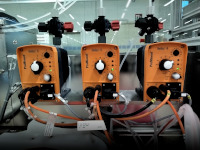
Set-up of automatic dosing systems, including for several cleaners, in a continuous cleaning line.
Process setup for ultra-clean optics — high requirements
Implementation of a cleaning process for optics, particle-free down to below 100 nm. Verified by special reflected-light microscopy. Factory Acceptance Test (FAT) performed.
Quality control
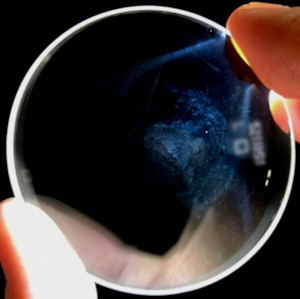
Hard coating optimisation — eyeglass manufacturers (DE, IT)
Dip and spin coating processes optimised alongside cleaning. Rework rate for special glass types reduced significantly.
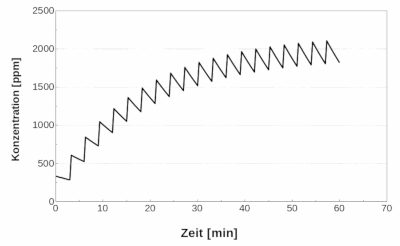
Example: Concentration

Cleaning tank: Change of concentration over several hours due to carryover.
Cooling lubricant substitution
Surface contamination traced back to the cooling lubricant, not the cleaning process. New lubricant specified — problem resolved without changing the cleaning line at all.
Example: Comparison
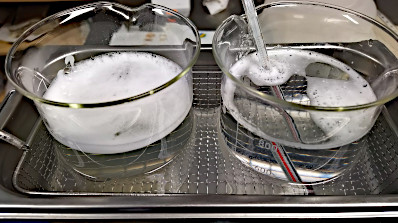
Simple comparison of two different cleaners.
Polishing agent removal — multi-chamber system
Targeted modification of existing chemistry. Major improvement in polishing residue removal from optical glass. Stabilised through regular maintenance protocol.
Example: Enrichment
Rinsing tank: Enrichment from the previous cleaning tank due to carryover of detergent.
All project examples are anonymised. Implemented partly with cleaning agents from SAFECHEM Europe GmbH; individual projects are documented in their published application reports. I work freelance for several clients. For SAFECHEM Europe GmbH I act as an external application consultant on a fee basis.